
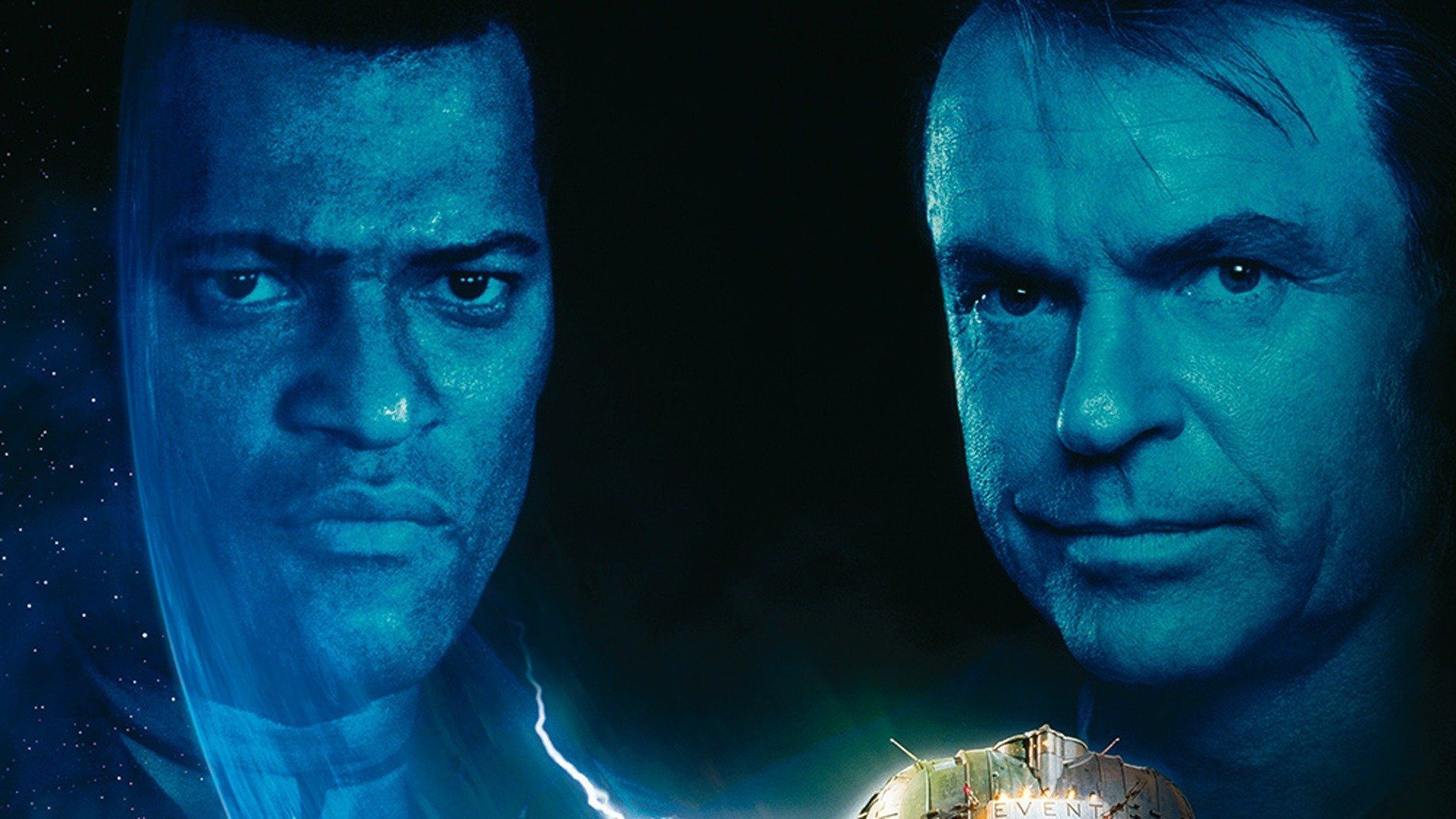
Event Horizon - Am Rande des Universums

Event Horizon - Am Rande des Universums ansehen bei










- RipLinesMan20. April 2025When comparing Event Horizon (1997) to Event Horizon (1997), one might expect redundancy, but instead, what unfolds is a recursive nightmare, a Möbius strip of horror cinema that folds terror into itself. No matter which angle you enter from, it feels like another layer is waiting, another descent into the same suffering, but told by a darker voice. Like two mirrors facing each other in a cathedral of fire, the film reflects its own torment back and forth until only darkness remains. In terms of atmosphere, Event Horizon (1997) edges itself out only by the thickness of the blood in its airlocks. It’s drenched in dread, but somehow manages to make even silence feel like a character screaming under its breath. The ship breathes like a beast baptized in sulfur, its walls exhaling rot and prophecy. Every corridor is a sermon from the damned, echoing with the cries of saints turned sinners. The air onboard is not oxygen. It’s purgatory made breathable. Even the silence has weight, a leaden pause before damnation reads your name aloud. The absence of life is not emptiness here. It’s judgment made visible. The characters, as written, as performed, as condemned, are not merely people. They’re archetypes shaped by guilt. Captain Miller is the reluctant guardian standing at the gates of a ship-shaped Gehenna. Dr. Weir is a fallen oracle pulling back the veil, not to escape damnation, but to embrace it. Their confrontation is not a climax. It’s a theological argument conducted through screams and imploding metal. Every crew member carries a cross, whether etched in regret or forged in memory. Justin’s journey into the void is a baptism by vacuum. Peters doesn’t just grieve. She is devoured by it. D.J. meets his fate with eyes open, as if recognizing his tormentor like an old friend. Characters don’t board the Event Horizon. They are summoned. The ship itself is not a vessel but a sanctum of pain. It generates sin the way a furnace emits heat: constantly, unconsciously, eternally. The gravity drive isn’t a machine. It’s a sacrificial altar, a heart of black iron pumping regret. The log recording the screams of the previous crew plays like a hymn sung in reverse, a gospel of torment carried across dimensions. The ship doesn’t return from somewhere. It brings somewhere back with it. The ship’s return from beyond is not an event. It’s an infection. Its presence isn’t narrative. It’s parasitic, invading the film until even the structure begins to rot. You feel it in the edits, the glances, the way the characters pause, not out of fear of what’s ahead, but because they realize they’ve already been condemned. The bridge offers control, but only as illusion. The same codes, the same systems, yet power always slips through like ash through desperate fingers. No scene in Event Horizon exists to entertain. Each is a rung on a ladder descending into something unknowable. The film doesn’t escalate. It peels. Every hallucination is a sermon in reverse. Every flashback is a flaying. The camera doesn’t glide. It crawls, like a witness too afraid to speak. Visual motifs echo like ancient liturgies. The spinning core is not technology. It’s a relic of spiritual horror. The red filters, the spinning corridors, they don’t resemble veins. They are veins. The ship is alive, and it does not want you to leave. The horror is infernal, a slow-burning collapse of theology, logic, and sanity. Event Horizon doesn’t scare you. It converts you. Fire doesn’t destroy here. It sanctifies. What lies behind the core isn’t science. It’s scripture. It is knowledge twisted until it screams. Even when you blink, the images burn on. They’re not memories. They’re permanent additions to the soul’s architecture. Event Horizon is a ritual disguised as a narrative, a liturgy of suffering bound to reel and runtime. Watching it once is a haunting. Watching it again is a communion. There are no different perspectives, only recursions, each bleeding into the other, until you’re unsure whether you’re experiencing a film or being initiated into it. To compare Event Horizon to itself is to realize it contains its own duality. The ship is both arrival and return. The horror is both external and born of the viewer. The hallucinations are unique, but they all speak the same sermon: guilt, grief, sin, and surrender. It is a film that demands interpretation but punishes understanding. It gives you no monsters to blame, only mirrors to stare into. What separates Event Horizon from other horror is its complete conviction. There is no wink. No relief. No escape hatch. It invites you in, shows you what lies beyond reason, and dares you to blink. And whether you see it in darkness, in memory, or in dreams, hell is always watching back. To stare too long at Event Horizon (1997) is to feel it reshape itself inside you. You may forget the plot. You’ll never forget the feeling. It’s not a movie you rewatch. It’s a scripture you retranslate. Each viewing brings revelation. And revelation always hurts. To compare Event Horizon to itself is to stare into a spiraling void and realize the patterns aren’t reflections. They’re instructions. And the more you understand, the deeper it buries itself in you. It is a monument to irreversible knowledge, a cinematic grimoire that leaves scorch marks on the soul. In the end, the question isn’t which part is better. The question is: how much can you take? And the answer is always the same. Just enough to be marked by it forever.
- AngusMcNutz26. März 2025Film is such a weird industry. You can be one of the most tactless, schlock, franchise-rolling filmmakers around and, somehow, you just may end up creating an insanely ambitious, genre-defining classic. If there was ever anything that came close to capturing the tension and meticulous escalation that Alien had, it’s here. Blood for the Blood God.
- PhysicalMedia4Life20. Mai 2026If someone ever asked me what's the one movie that has unseen or lost footage that you would wish to see it would 💯 without a doubt be Event Horizon's lost & unseen footage. What I wouldn't give to see the full version of "Event Horizon" it's such a damn shame that we'll never get to see it. This is also the best ever film by a country mile that "Paul WS Anderson" has ever directed. I just love the whole aesthetic of the ship. And it has that really eerie atmosphere & isolation accompanied by that sense of dread about it as well, a lot like Ridley Scott's Alien in that aspect.
- Rick Fox30. April 2026Paul WS Anderson’s best film to date. Great cast, cinematography, and story. Unfortunately it falls short of true greatness due to its editing. Many scenes were cut to have a shorter run time in order to maximize theater showtimes. I hope this film gets a reboot so Anderson can get a chance to tell the story he really wanted to tell.
- hairydemon2. Oktober 2025It has aged well. Originally, when it came out I thought it was derivative, cringey and a bad rip off of a bunch of films. Hellraiser meets Alien. It seemed like an expensive parody. But in 2025, it has grown into itself as quite a good scifi, and even horror, film. Its pastiche influences now look like a revered homage to a better era when things were original. It is in fact quite a good film. (shock. horror, yes a Paul WS Anderson film is good!) Could it be that Scifi has declined so far (Alien Eath for example) that this looks like high art in comparision? Whichever way, a great cast do a good job of a fun 90 mins. And I love the model fx! Much cooler than cgi!


Plex auf deine Abspielgeräte
Kostenlos auf 20+ Plattformen. Wähle deine.Event Horizon - Am Rande des Universums Trivia
Event Horizon - Am Rande des Universums wurde am 15. August 1997 veröffentlicht.
Regie in Event Horizon - Am Rande des Universums führte(n) Paul W. S. Anderson.
Event Horizon - Am Rande des Universums hat eine Spielzeit von 1 Std., 35 Min..
Event Horizon - Am Rande des Universums wurde produziert von Jeremy Bolt, Lawrence Gordon, Lloyd Levin.
Wir schreiben das Jahr 2047. Einige Jahre zuvor verschwand das Forschungsraumschiff “Event Horizon” spurlos. Jetzt wurde ein Signal empfangen und die amerikanische Raumfahrtbehörde reagiert sofort. Ein kompromissloser Captain, seine Elite-Crew und der Konstrukteur des vermissten Raumschiffs werden auf die Suche nach der Quelle des Signals geschickt. Ihr Auftrag: den Mega-Raumkreuzer zu finden und zu bergen. Was sie finden, ist unvorstellbarer Terror. Was sie retten müssen, ist ihr Leben. Denn irgendjemand oder irgendetwas wartet nur darauf, sie in eine neue Dimension unvorstellbaren Schreckens zu stoßen.
Die Hauptcharaktere in Event Horizon - Am Rande des Universums sind Miller (Laurence Fishburne), Weir (Sam Neill), Peters (Kathleen Quinlan).
Event Horizon - Am Rande des Universums ist bewertet mit 16.
Event Horizon - Am Rande des Universums ist eine Horror, Science Fiction, Thriller Film.
Event Horizon - Am Rande des Universums hat eine Benutzerbewertung von 6.2 von 10.
Event Horizon - Am Rande des Universums hatte ein Budget von 60 Mio. $.
Event Horizon - Am Rande des Universums erzielte Einnhamen von 26,7 Mio. $ an den Kinokassen.