


Moby Dick ansehen bei













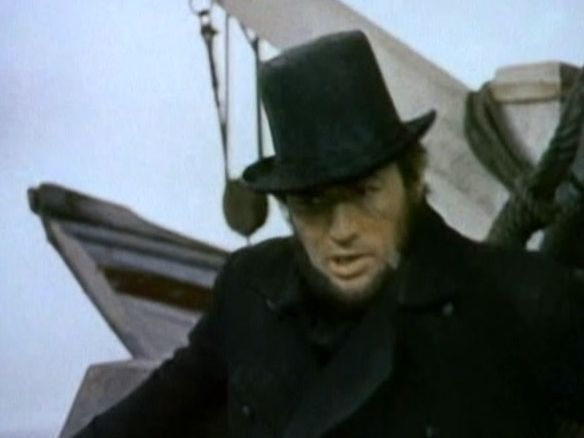
- CrossCutCritic29. April 2025Of Whales and Gods and Men Turned Inward. --- “Call me Ishmael.” A beginning disguised as detachment — but beneath it lies exile. Few opening lines in literature carry such weight. It is not just an introduction. It is a confession. So begins Moby Dick, Herman Melville’s leviathan novel brought to cinematic life by John Huston in 1956. This adaptation, co-written with Ray Bradbury, is reverent to the source but carved down to fit the shape of film. What remains is stark and strange: a grimly beautiful film that refuses the conventions of adventure and instead offers something bleaker, truer, older — a confrontation with the raw mysteries of providence and the unfathomable freedom of the will. --- Gregory Peck’s Captain Ahab is a gaunt figure — less a man than a scar walking upright. He commands the screen not with bombast but with gravity. His voice, measured and meditative, cuts like scripture half-remembered and half-rewritten. Ahab is not simply chasing a whale. He is chasing God, masked in flesh and fin. He believes the whale is more than a brute beast. He believes it bears intention — malice, even. And to kill it is to strike through the pasteboard mask of all suffering, all injustice, all divine silence. --- The sea here is not merely backdrop. It is unformed, primeval, terrifying — the Book of Job rendered in waves. It is the stage upon which men are unmade. Ishmael (Richard Basehart), our narrator, is never quite our guide. He is a witness. He sees much, understands little, survives barely. And yet it is from him — not Ahab, not the crew, not the god-haunted sermon of Father Mapple (delivered with strange, trembling power by Orson Welles) — that the story is remembered. He lives. He tells. --- There is no simple hero in Moby Dick, no clarity of good and evil. There is only mystery — the mystery of God, of evil, of human will turned inward and burning with obsession. Ahab is a man incurvatus in se — curved in upon himself, to borrow Augustine’s phrase later beloved by Luther. He cannot bow to God, so he must strike. He must command where he cannot trust. He must master what terrifies him. His is not unbelief. It is belief gone feral — belief without surrender, without grace. Ahab believes in providence, but not mercy. In wrath, but not compassion. He would rather damn himself on his own terms than be saved on God’s. --- And yet, Huston’s film never mocks him. It lets him burn. The Pequod, like the world itself, becomes a floating parable of the human condition: A company of men, each trying to make peace with the deep in their own way. Some pray. Some drink. Some obey. Ahab rages. But the whale does not rage. It swims. Silent. Oblivious. Or perhaps not. --- The genius of Moby Dick is that it offers no resolution. The whale is not defeated. God does not answer. Ahab perishes in the hunt. And Ishmael is left, floating in the wreckage, clinging to the coffin of his friend. It is here, in this grim tableau, that something like grace appears — but not triumphant, not glorious. It is a grace that saves one man from drowning. No more. No less. It is not enough to make sense of the story. But it is enough to remember it. --- What does it mean that only the one who never sought vengeance survives? What does it say that salvation comes not to the righteous, but to the one who finally lets go? If Moby Dick is a film about the hidden God — then perhaps Ishmael’s survival is its only whisper of the revealed one. Not in the conquest of the whale, but in the endurance of the wrecked. Not in power, but in the voice that still speaks from the water’s edge: "Call me..." And waits.


Plex auf deine Abspielgeräte
Kostenlos auf 20+ Plattformen. Wähle deine.Moby Dick Trivia
Moby Dick wurde am 29. August 1956 veröffentlicht.
Regie in Moby Dick führte(n) John Huston.
Moby Dick hat eine Spielzeit von 1 Std., 55 Min..
Moby Dick wurde produziert von John Huston, Vaughan N. Dean.
Obwohl sie vom wahnsinnig wirkenden Elias davor gewarnt werden, heuern der Matrose Ismael und der Harpunier Queequeg auf dem Walfangschiff „Pequod“ an. Dass sich Ahab, der Kapitän dieses Schiffs, an Bord befindet, vermittelt sich ihnen in den ersten Tagen auf See nur durch die Geräusche, die sein künstliches Bein nachts auf Deck verursacht. Schließlich bekommen sie ihn zu Gesicht. Ahab trägt eine Beinprothese, die aus dem Kieferknochen eines Pottwals angefertigt worden ist. Dieser ungewöhnliche Werkstoff ist damit zu erklären, dass der Kapitän einen weißen Wal namens Moby Dick für den Verlust seines Beins verantwortlich macht.
Die Hauptcharaktere in Moby Dick sind Captain Ahab (Gregory Peck), Ishmael (Richard Basehart), Starbuck (Leo Genn).
Moby Dick ist bewertet mit 12.
Moby Dick its ein Adventure, Drama Film.
Moby Dick hat eine Benutzerbewertung von 7.3 von 10.
Moby Dick hatte ein Budget von 4,5 Mio. $.
Moby Dick erzielte Einnhamen von 10,4 Mio. $ an den Kinokassen.