TidspatruljenSæson 12
A group of archaeologists have 3 days to discover historical artifacts in different sites around Britain.
Hvor man kan se Tidspatruljen • Sæson 12
13 episoder
- The Manor That's Back to Front - Chenies Manor House, Buckinghamshire
 E1
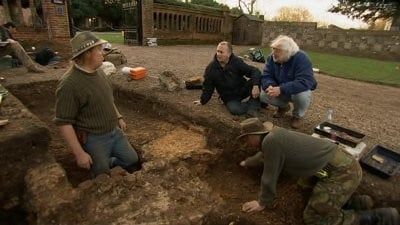
E1The Manor That's Back to Front - Chenies Manor House, BuckinghamshireTony Robinson and the team visit Chenies Manor which is believed to have been upgraded in time for Henry VIII's visit around 1530. However, while a late 16th-century inventory suggests that an additional range of rooms fit for a king once existed, traces of them have vanished since the house fell into disrepair. Can the experts uncover the layout of the building as it appeared in Tudor times? - The Monastery and the Mansion - Nether Poppleton, Yorkshire
 E2
E2The Monastery and the Mansion - Nether Poppleton, YorkshireThe villagers of Nether Poppleton, near York, join Tony Robinson and the team for some extensive digging as they try to determine the exact age of their village. The current layout follows a typical medieval pattern but a reference to the village in the Domesday Book has the experts thinking that it could date back to Saxon times at least. - The Bombers in the Marsh - Warton near Preston, Lancashire
 E3
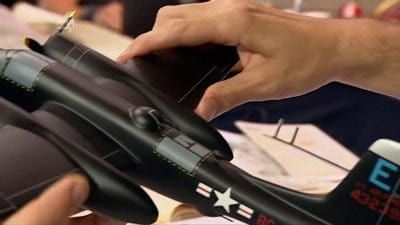
E3The Bombers in the Marsh - Warton near Preston, LancashireIn three days, the team unearth one of two crashed USAF bombers and explain why they crashed. RAF recovery team, Unexploded Ordnance team and air crash experts are all on standby and are used. The crash is explained from evidence uncovered. Engines and fuselage are removed for permanent display. - Fighting On The Frontier - Drumlanrig, Dumfries and Galloway
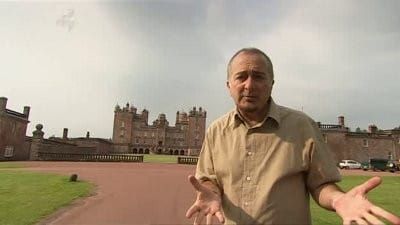 E4
E4Fighting On The Frontier - Drumlanrig, Dumfries and GallowayTwenty years ago, during a particularly dry summer, parch marks revealed what seemed to be a huge Roman fort a few hundred metres from the Duke of Buccleuch's extraordinarily grand house, Drumlanrig Castle, in Dumfries. The discovery lay untouched until Time Team took on the challenge to investigate it further. The Team sought to answer a number of questions. Was it actually a Roman fort? If so, it was one of the most northerly ever found and therefore of special importance to Scotland's history. So when were the Romans there? No finds made previously had given any hint of the date of the structure. Time Team also wanted to identify the roads leading in and out of the fort. Was there any kind of civilian settlement or other features nearby? And could the Team work out how the Romans made their famous draco, the military standard that made a sound said to have struck fear into the hearts of their enemies? - A Neolithic Cathedral? - Northborough, Peterborough
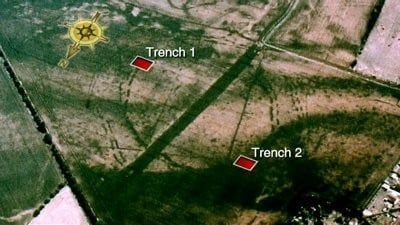 E5
E5A Neolithic Cathedral? - Northborough, PeterboroughThe Time Team is invited to a huge circular crop mark near Peterborough, referred to as a causewayed enclosure by archaeologists. Huge ditches mark the area, which date the site at around 6,000 years old. Some believe the ditches to be evidence of farming, others that they are of religious origin. Francis Pryor and Ben Robinson join the team to get to the bottom of the mystery in just three days. - In Search of Henry V's Flagship, Grace Dieu - Bursledon, Hampshire
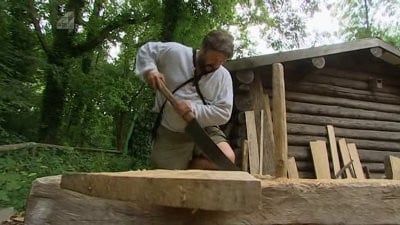 E6
E6In Search of Henry V's Flagship, Grace Dieu - Bursledon, HampshireThe team have three days to explore the skeleton of a medieval warship found on the bed of the River Hamble near Southampton. They must prove whether it is the Grace Dieu, Henry V's naval flagship, and also find out how big it was and just why it came to grief. The team are joined by John Adams (marine archeologist) and Susan Rose (historian). Damian Goodburn (ancient ship expert) attempts to reproduce a small section of the massive ship's clinker built hull. - Going Upmarket With The Romans - Standish, Gloucestershire
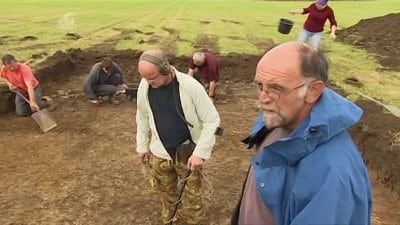 E7
E7Going Upmarket With The Romans - Standish, GloucestershireFor years, a field near Standish in Gloucestershire has yielded Roman brooches, mosaic tiles and coins. The finds point to a sizeable villa somewhere nearby - but so far none has been found. Tony Robinson and the team have just three days to solve the mystery. There are plenty of signs that people lived in the area from the Iron Age through to the Roman period, but no sign of the villa. But clue by clue the archaeologists piece together the puzzle to reveal an extraordinary picture of several generations of one family living through huge social change and gradually improving their lifestyle as Romanised Britain became more and more prosperous. - Picts And Hermits: Cave Dwellers Of Fife - Wemyss, Fife
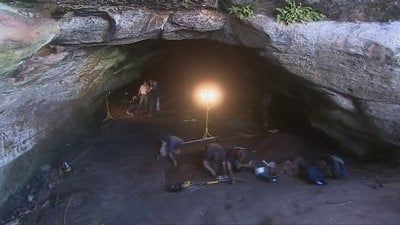 E8
E8Picts And Hermits: Cave Dwellers Of Fife - Wemyss, FifeJonathan's Cave, Sloping Cave and Well Cave at Wemyss have had continuous use since Pictish times. They dig through many layers of occupation. Is there a passageway between Well cave and MacDuff castle above? - Lost Centuries Of St Osyth - St Osyth, Essex
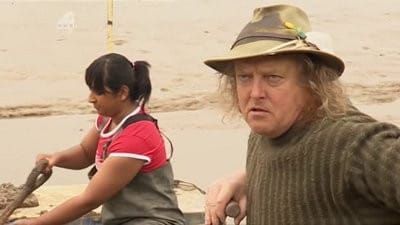 E9
E9Lost Centuries Of St Osyth - St Osyth, EssexA variety of places are dug, revealing medieval pottery and occupation, showing St Osyth village was an active port. A wharf is dug between tides. The adjoining field shows industry along the creek. Inland finds support this theory. - The Puzzle Of Picket's Farm - South Perrott, Dorset
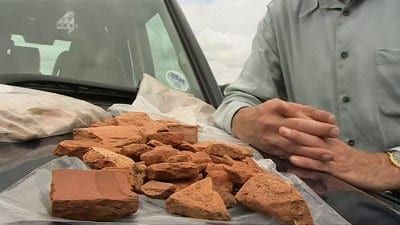 E10
E10The Puzzle Of Picket's Farm - South Perrott, DorsetTime Team heads to South Perrott in Dorset, inspired by the intriguing discovery of Roman brooches and coins in a hilltop field. The Team are pretty sure they're going to uncover a Roman Temple, but the search gets off to a bad start when all the pottery turns out to be medieval and there's no sign of any buildings. Something has clearly been going on in this field, but it's not what they thought. The trenches gradually reveal their contents, painting a very different picture from a very different period. Have the Team stumbled across a Stone Age burial site that had, extraordinarily, been honoured for thousands of years right into Roman times? Prehistory specialist Miles Russell explains some aspects of Bronze Age features. - Norman Neighbours - Skipsea, East Yorkshire
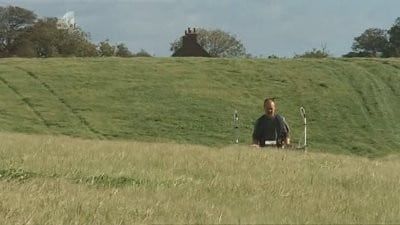 E11
E11Norman Neighbours - Skipsea, East YorkshireFor years Time Team fan Frances Davies has been collecting finds from the field outside her back door in Skipsea in East Yorkshire. She has uncovered Neolithic, Roman and Saxon items, but her best finds are medieval pots dating from the Norman Conquest. It's clear that there was some habitation in the area 1,000 years ago, but a geophysics plot of the site reveals incredible results, far beyond the team's expectations. Could Frances have had a whole Norman village in her field, a village lost to the records? And could there be a clue in nearby Skipsea Castle, the seat of power of the Norman overlord of the whole area? The Team have three days to find out. - Tower Blocks And Togas - South Shields, Tyneside
 E12
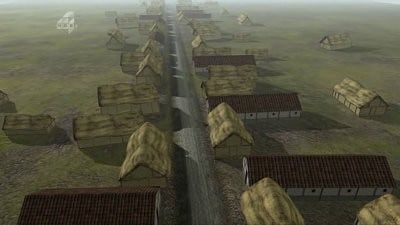
E12Tower Blocks And Togas - South Shields, TynesideIn South Shields, the Roman Fort at the end of Hadrian's Wall is a local landmark and the team embark on a quest to locate the site of a huge Roman military cemetery thought to be in the area. They search all nearby open spaces but come to the conclusion that the likeliest site of the cemetery is beneath a 1960s housing estate. A few tombstones and burials have been found in the past hundred years, but there must be a huge Roman military cemetery somewhere. Time Team use every spare piece of open space, have a look under the occasional pavement and enlist as much local help, young and old, as possible in their hunt for the site. It's three days of head-scratching mayhem before the answer emerges. - Animal Farm - Hanslope, Milton Keynes
 E13
E13Animal Farm - Hanslope, Milton KeynesFinds point towards a farm building rather than a dwelling. Crop marks suggest prehistoric but pottery says medieval. The area was designated a hunting forest, possibly pigs were bred to stock the forest for medieval sport. Forest was an area of land not necessarily covered in trees but with special rights.