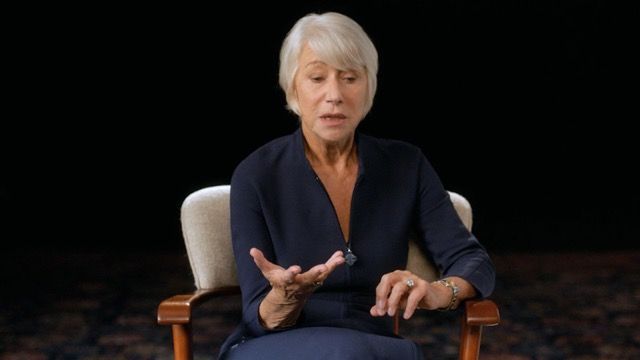
MasterClassHelen Mirren Teaches Acting

Oscar, Golden Globe, Emmy, and Tony winner Helen Mirren is one of the greatest actresses of our time. In her first online class, she discusses the dualism that is core to her method: the necessity for mastering technique (craft) and then letting go so that your imagination can take over (art). Learn how to break down a script, research characters, and master techniques so you can transcend them to find freedom in every role.

Where to Watch MasterClass • Helen Mirren Teaches Acting

28 Episodes

  • Introduction
    A1
    IntroductionTo start her MasterClass, Helen demonstrates a simple act that’s one of the hardest things for an actor to do: walking naturally. She then introduces you to the world of acting and the empty space that will be your classroom.
  • Helen’s Journey in the Theater
    A2
    Helen’s Journey in the TheaterHelen talks about the beginning of her career and the events that inspired her to become an actress, from an amateur production of Hamlet to a variety show in her hometown.
  • Evolving as a Theater Actress
    A3
    Evolving as a Theater ActressWhile performing with an experimental theater group, Helen learned valuable lessons about voice training, physicality, and control. Here, she shares them with you.
  • Choosing Roles
    A4
    Choosing RolesHelen offers you advice for auditions and shares her unique way of assessing a role.
  • Breaking Down a Script
    A5
    Breaking Down a ScriptBreaking down a script is a very personal process. Learn Helen’s tricks for tackling a large volume of material at once, and experience the joy of discovering your character’s dialogue in your own mouth.
  • Shakespeare, Part 1
    A6
    Shakespeare, Part 1Helen shares her process for breaking down a Shakespeare passage by working through Portia’s “Quality of Mercy” speech from The Merchant of Venice, a monologue she’s never performed before.
  • Shakespeare, Part 2
    A7
    Shakespeare, Part 2Helen breaks down her favorite speech—“Our Revels” from The Tempest—giving you insight into her deeply personal relationship with the lines.
  • Finding Your Character
    A8
    Finding Your CharacterReal life is one of Helen’s greatest inspirations—she says it will always be better than anything we can invent. Learn how to find your character in the world around you and the importance of having a secret story that drives you in every role.
  • Research: Fictional Characters
    A9
    Research: Fictional CharactersHelen breaks down her two types of research—literal and poetic—and emphasizes the importance of researching the people in your character’s profession, rather than just the profession itself.
  • Research: Real Characters
    A10
    Research: Real CharactersLearn how Helen approached research for historical roles such as Elizabeth I, Elizabeth II, and Ayn Rand.
  • Creating Characters: Costume, Part 1
    A11
    Creating Characters: Costume, Part 1Helen has a deep enthusiasm for costume. She walks you through how various costumes serve the characters who wear them and how to make more thoughtful choices about what your characters wear.
  • Creating Characters: Costume, Part 2
    A12
    Creating Characters: Costume, Part 2Every piece of your character’s costume—down to the shoes—has to tell the right story. Learn how to evaluate accessories for your character.
  • Creating Characters: Hair & Makeup, Part 1
    A13
    Creating Characters: Hair & Makeup, Part 1Helen teaches you to let go of vanity and approach hair and makeup through the lens of your character.
  • Creating Characters: Hair & Makeup, Part 2
    A14
    Creating Characters: Hair & Makeup, Part 2For Helen, an actor’s face is an “empty space,” just like a stage, on which characters come to life and tell their stories.
  • Preparation and Rehearsal
    A15
    Preparation and RehearsalHelen advises you on aspects of the preparation and rehearsal process, from learning your lines to working with a dialect coach to overcoming creative blocks.
  • Human Behavior
    A16
    Human BehaviorLearn the essential human behaviors and aspects of the human experience you’ll need in your toolbox throughout your acting career.
  • Film Acting Technique, Part 1
    A17
    Film Acting Technique, Part 1For Helen, mastering on-camera technique allowed her to find freedom in her roles and to have moments of pure, out-of-control inspiration. She shares how she found inspiration in this vein from a surprising source: an abstract painter.
  • Film Acting Technique, Part 2
    A18
    Film Acting Technique, Part 2Helen dives into the nitty-gritty of working to camera, sharing advice for staying oriented on set and reserving your energy and emotions for your coverage on camera. She also encourages you not to obsess over every take.
  • Film Acting Technique, Part 3
    A19
    Film Acting Technique, Part 3Learn how to drop into character right before a take, how to stay grounded in your process, and how to give your best performance amid the distractions on set.
  • Case Study: Prime Suspect
    A20
    Case Study: Prime SuspectClose-up shots are an opportunity to show your character’s emotions and thoughts without putting words to them. Helen breaks down a scene from the first episode of Prime Suspect to illustrate.
  • Case Study: Elizabeth I
    A21
    Case Study: Elizabeth ILearn the two-track thinking required to have an impactful performance on camera: You must play the emotional moment of the scene in real time while knowing exactly where the camera is.
  • Case Study: The Queen
    A22
    Case Study: The QueenHelen breaks down two powerful moments of her Academy Award–winning performance in The Queen, illustrating how she reveals the nuances of her character without saying a word.
  • Acting on a Film Set
    A23
    Acting on a Film SetHelen gives you a unique look at what acting on a film set is actually like and shares the key to success when working to camera: concentration.
  • Characterizing the Set
    A24
    Characterizing the SetActors may overlook details of set decoration, but Helen encourages you to think about what set dressing can say about your character. Learn how changing the dressing of a set can tell different stories about the character who lives there.
  • Props
    A25
    PropsFor Helen, props are an extension of your character. Learn how to use them naturally on camera while also cultivating an awareness of the demands of continuity.
  • Working With Writers & Directors
    A26
    Working With Writers & DirectorsHelen advises you on how to create successful relationships with writers and directors, and she shares lessons learned from working with renowned director Robert Altman on the film Gosford Park.
  • Conclusion
    A27
    ConclusionHelen shares her final thoughts and leaves you with her practical—and delightfully blunt—advice for young actors.
  • Bonus: Naturalism
    A28
    Bonus: NaturalismDiscover which film actors had the biggest influence on Helen and why their work is so important to her.

Get Plex on Your Devices

Free on 20+ platforms. Pick yours.
See all supported devices →