
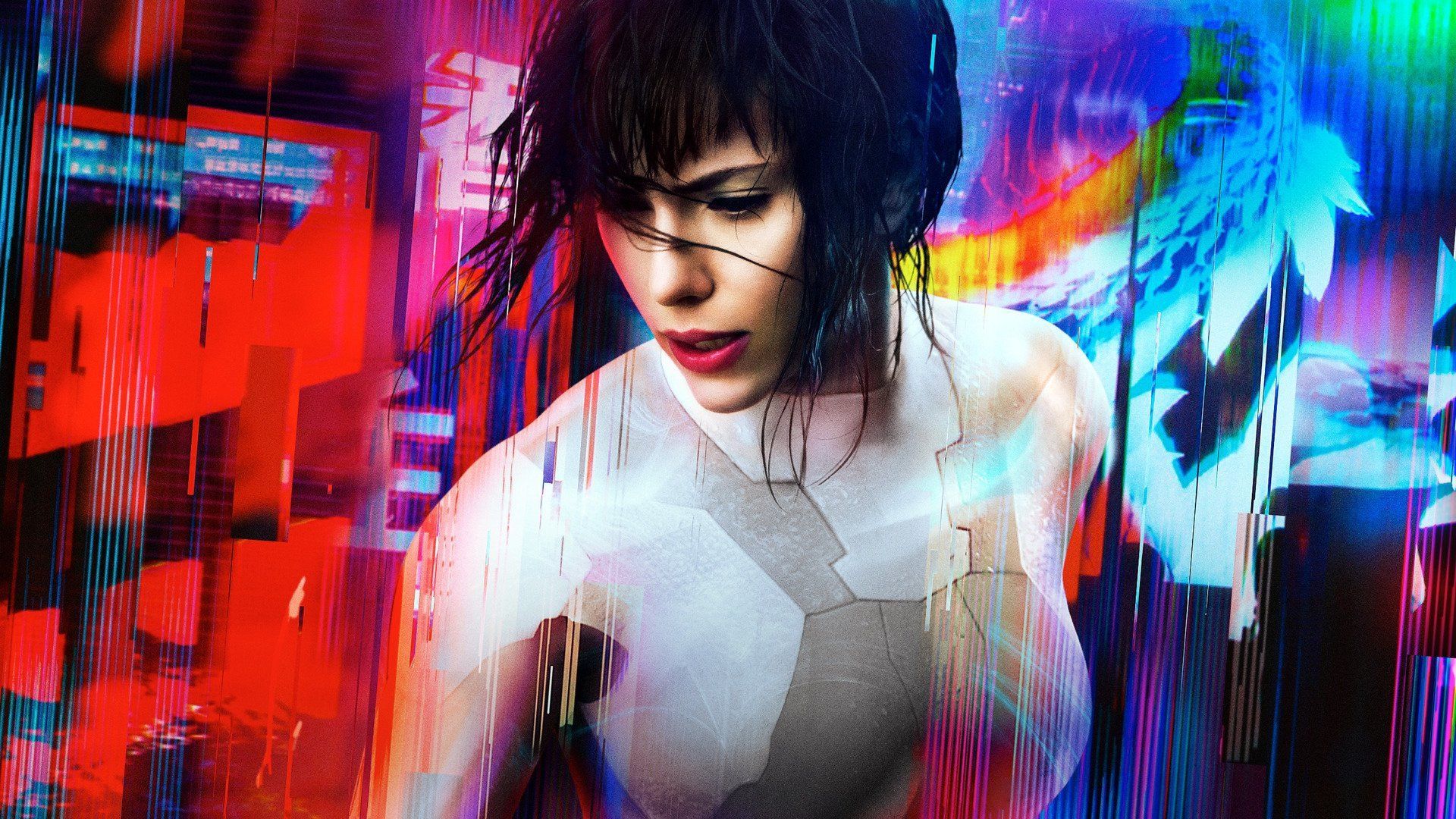
Ghost in the Shell

Ghost in the Shell ansehen bei
















- Daiken Seige18. Juni 2026I don't understand how people say this is a horrible movie and a horrible adaptation of the source. This movie is a very faithful adaptation of the original movie. Now I know things were changed but it has to happen to appeal to non fans and that's the case to ever movie and show that is made. The acting is great. Black Widow did a great job playing the Major. The dead pan delivery and lack of emotions that she shows plays well as it did in the original. Bato was great, The chief perfect casting. If you wanna talk about the story being off well yeah. They adapted the original story and pieces of the first OVA The Laughing Man. It wasn't perfect but it was damn good. Keep an open mind and watch it. People will always find the bad in anything. Watch it and enjoy. Oh the soundtrack.... Amazing and faithful. Steve Ako (I know I'm miss spelling it) did an amazing job.
- bioradj30. Mai 2025The amount of exposition just shows how stupid they thought the audience would be. The greatness of Japanese story telling is the lack of knowledge in the early stages of a story that require the audience to pay attention and invest in the narrative. All of the changes in this film are pandering to dimwitted audiences. If you've felt the peaceful intelligence of the anime, this film feels like being beaten with a sack of oranges.
- Gwyneth Llewelyn14. Januar 2026I'm not (yet?) a hard-core fan of the "Ghost in the Shell" franchise; and I'm neither Japanese nor American to feel profoundly offended that the lead character is played by an American actress — the beautiful and immensely talented Scarlett Johannsen — instead of a Japanese actress. As such, neither of these controversial topics prevented me from enthusiastically watching this delightful movie, and appreciating it immensely. It's one of the features of the franchise that, over the three decades of manga/anime/OVA/full featured animation movies/live-action movies, the overall setting and plot are kept more or the less uniform (the principle of least surprise!), but some essential details are changed, according to the whims of the mangaka/animation directors/movie directors — especially those relating to the characters themselves, their backgrounds, their personal backgrounds, and even their personality. The Major, in particular, in spite of being the main character in all of the franchise, is also probably the one that changes most. As such, fans will either utterly hate the "new Major", or get to love them so much in the current incarnation, praising the authors for the "change to the best". Either reaction is totally possible — the only thing that is impossible is to remain indifferent! "Ghost in the Shell" is 100% pure cyberpunk of the highest quality. Its premises and subsequent narrative is absolutely perfect — all the authors, over the past three decades, should collectively win a Nobel Prize for Literature. Obviously, each author has their own style, and a slightly different focus on what they consider to be important; but the ultimate *core* of "Ghost in the Shell" is intrinsically preserved, almost intact, since the very beginning. The rest is pure action, a flawless plot, reasonable acting and great actor direction, and, of course, special effects. The cyberpunk city *lives*. It's as realistic — or more — than, say, Blade Runner, perhaps the cyberpunk movie which first explored the genre on the silver screen, at a time when, literarily speaking, cyberpunk was entering its Golden Age. The key writers of this period (Gibson and Sterling), by the mid-1990s, decided that cyberpunk was "dead" as a genre, because it explored everything it could, and it was time to abandon it in favour of different styles. That might be academically correct (or not), but, fortunately for us cyberpunk lovers, "Ghost in the Shell" was born to prove that cyberpunk wasn't yet dead — and, three decades later, it's still gloriously alive. I won't mention anything about the plot — no spoilers here — but just to comment on how one of the die-hard fans already reviewed this movie, which, for him, was utterly disappointing. Not because of Scarlett, but rather because of the way the story is presented to an audience in 2025. There is a vast — incredibly vast — amount of material produced by the many authors contributing to the "Ghost in the Shell" franchise. One of the main features of all the narratives was a strict adherence to the simple principle of "no infodumping", or, as the science-fiction savants call it, the "As you know, Bob..." moments, when the characters reveal a (usually important but incomprehensible) detail of the narrative; in science fiction, this is most often linked to explaining how some bit of technology works. Serious science fiction writers abhor "infodumping": they show, not tell, how things work. It's part of the job of the reader/viewer to figure out the details for themselves. In "real life", we don't spend all the time explaining to other people how, say, smartphones work. We show them the apps we've installed. Thus, the suspension of disbelief is better achieved when there are almost zero "infodumping moments" and lots of opportunities to show how things work in this fictional universe. Let's give an example from what was perhaps the attempt at the most hard-core science fiction movie ever: "2001". Kubrick is not only a genius, he's also the ultimate perfectionist to the point of obsession. If you watch this movie today, you'll probably notice that there is a scene when people are having breakfast or lunch, while reading the news on a flat-screen tablet. That's right — 40 years before they were invented, Kubrick shows them in action. People use it to watch pictures, to see the news, to keep track of the stock exchange — whatever. It's irrelevant. We are not told how the devices work, or what technology they employ — we just see how people use them. Similarly, we hardly have zero details on how "HAL" works. We know it's a computer behind it, just because Dave turns it off. We know it has pattern recognition via camera vision; we know it masters chess and can talk fluently in a quasi-human way (i.e., not a robot) — exactly like contemporary Large Language Models (such as ChatGPT, Gemini, or Claude do today). We also know that "HAL" makes mistakes (as we also know from our interactions with LLMs today) and errors of judgement. Does Kubrick tell us HOW? No. He does not say much about HAL. He just shows how HAL is "part of the crew", how humans rely on it to keep the ship going, and so forth. We also see that HAL does NOT have a human brain or a human hidden inside it — because we are shown how HAL gets disconnected. That's it. All the rest is up to the viewer to figure out, or imagine; the characters are NOT explaining anything about what HAL is or what it does. We infer that from the interactions they have with it. I believe that the words "artificial intelligence" is only mentioned once, when HAL gets disconnected (I would have to watch the movie again); AI, by that time, was well over a decade "old" and not exactly a strange, unfamiliar concept. "Ghost in the Shell", while using an obviously completely different background, uses the same style of narrative: show, not tell. It's easier when you have a graphical element (such as manga, anime, or movies), but the great writers do the same with words only. Everything in "Ghost in the Shell" is shown, never told. For instance, early in the series — and in the movie as well — the reader learns that people, in this universe, can get "hacked" and infected with a "computer virus" that somehow "takes over" their brain functions. We might wonder, how is that possible? How can a human brain be "hacked"? That's absurd! It's just much later that we eventually realise that the human brain doesn't get "hacked". What happens is that people have a brain implant, allowing them to directly interface with a computer device via thought processes alone (Elon Musk is doing precisely that with one of his companies). This "cyberbrain" is a computer, that can be connected to the Internet, and it's the computer that gets hacked — not the human! What simply happens is that some nasty side-effects can be produced and exploited by malicious agents. But all this explanation never appears anywhere. And we're left wondering, but how many people actually have those implants? As it happens, "almost anyone" (over 9 years, I think, with some exceptions), society wouldn't work otherwise, in the same way that we rely on having a smartphone in our pockets at all times — everywhere in the world, even in the poorest countries. Then we see that some characters, such as the Major, seem to have extraordinary superpowers — jumping across streets or rivers, effortlessly climbing skyscrapers, or fighting hand-to-hand under impossible conditions. They get shot but seem not to worry. How is everybody so invulnerable? We don't know, and nobody tells us — we just start having some glimpses of what's going on the first time a rifle shot blasts a hand away (or something similar) and it's clear that it's a robotic prosthetic. Good, now we learn that people use prosthetics. What kind? How many? And how far can we go? Nothing is answered, just shown. We learn that the Major is a "full-body prosthetic" — only her brain is human — since her tender age, but we also know this is rare. We know that there are plenty of robots around, with different levels of abilities; some, indeed, can be fully remotely controlled by anyone with a cyberbrain (and everybody has one). Thus, when a foe is faced, we — readers or viewers — have no idea what that thing is. Human? Android? Full-body prosthetic? A remotely-controlled robot? An autonomous robot with an AI? Or simply a hologram? All of the above are possible, and plenty more variants as well, so we are always surprised by whatever comes next: we never know in advance what's going on, and this is part of the charm of the franchise and thanks to the skill of its producers. That's also what makes us coming back for more stories. Even outside technology, the whole world is shrouded in mystery that is unveiled very slowly and progressively: we know there are still democracies, still superpowers, still complex diplomatic relationships. We might even learn that there were two more world wars; WWIII was nuclear, but not the next one. There was a catastrophic financial event that collapsed the whole world economy. But nobody tells us the complete story — just the occasional fragment. That's true even for the personal histories of the characters: there are almost no "flashbacks", or reminescenses, or characters explaining their backgrounds. When it matters, we get a glimpse of that. Most of the time, we have to infer everything on our own. Now *this* movie is not quite like that. For fans of the franchise, the story is not exactly "new", but that's ok, since the same story has been retold countless times over three decades and is just a tiny fragment in the vast universe. However, the producers of this movie decided to attract new viewers for this franchise. Which, as said, is extremely complex to explain. So what did they do? Infodumps. Way too many. And this is against the whole spirit of the franchise. That's the harshest critic we can make to an otherwise excellent movie...
- cyberbillp19. Mai 2026This really is a great movie. I've watched it five times or more (not counting the earlier animated version). It's dialog driven with great action sequences. But the action won't clue you into to what is happening at all. It's all in the dialog so you've got to pay attention. If you can wrap your head around it, this is solid gold. I wish they would follow up with part II, but I don't think they made enough money to get us a second film. You can always watch the animated one, but it's subtitled. sigh.
- Richard5. Oktober 2025The live-action film may shine in 4K, but my original DVD still holds the soul of the story. The 2017 adaptation is sleek, polished, and visually stunning. Watching it feels like stepping into a neon drenched future. The action is tight, the pacing brisk and the production design undeniably impressive. It borrows iconic scenes from the anime, the rooftop dive, the water fight,but reinterprets them with Hollywood flair. But the original 1995 anime? That’s where the philosophy lives. I remember the first time I watched it on DVD and all the sequels. The 2017 film simplifies much of that. It focuses more on Major’s past than her existential future, turning introspection into backstory. It’s more accessible, yes, but less mysterious and less poetic. So while the live action version dazzles, my DVD copy of the 1995 anime still feels like the real ghost in the shell. It’s the one I return to when I want to think and not just watch.


Schaue Ghost in the Shell Videos


Plex auf deine Abspielgeräte
Kostenlos auf 20+ Plattformen. Wähle deine.Ghost in the Shell Trivia
Ghost in the Shell wurde am 29. März 2017 veröffentlicht.
Regie in Ghost in the Shell führte(n) Rupert Sanders.
Ghost in the Shell hat eine Spielzeit von 1 Std., 46 Min..
Ghost in the Shell wurde produziert von Maguy R. Cohen, Steven Paul, Ari Arad, Avi Arad, Michael Costigan.
Major Kusanagi wurde als Cyborg wieder zum Leben erweckt und leitet eine Taskforce, die Cyber-Verbrecher jagt. Doch ein Hacker hat weitaus bombastischere Pläne.
Die Hauptcharaktere in Ghost in the Shell sind Major Mira Killian / Motoko Kusanagi (Scarlett Johansson), Aramaki (Takeshi Kitano), Batou (Pilou Asbæk).
Ghost in the Shell ist bewertet mit 16.
Ghost in the Shell ist eine Science Fiction, Mystery, Thriller Film.
Ghost in the Shell hat eine Benutzerbewertung von 5.1 von 10.
Ghost in the Shell hatte ein Budget von 110 Mio. $.
Ghost in the Shell erzielte Einnhamen von 169,8 Mio. $ an den Kinokassen.